
This is our third candidate questionnaire on housing issues in Tempe since 2020. We received responses from all but two candidates.
We will summarize the broad points below, but we encourage you to read the responses in full.
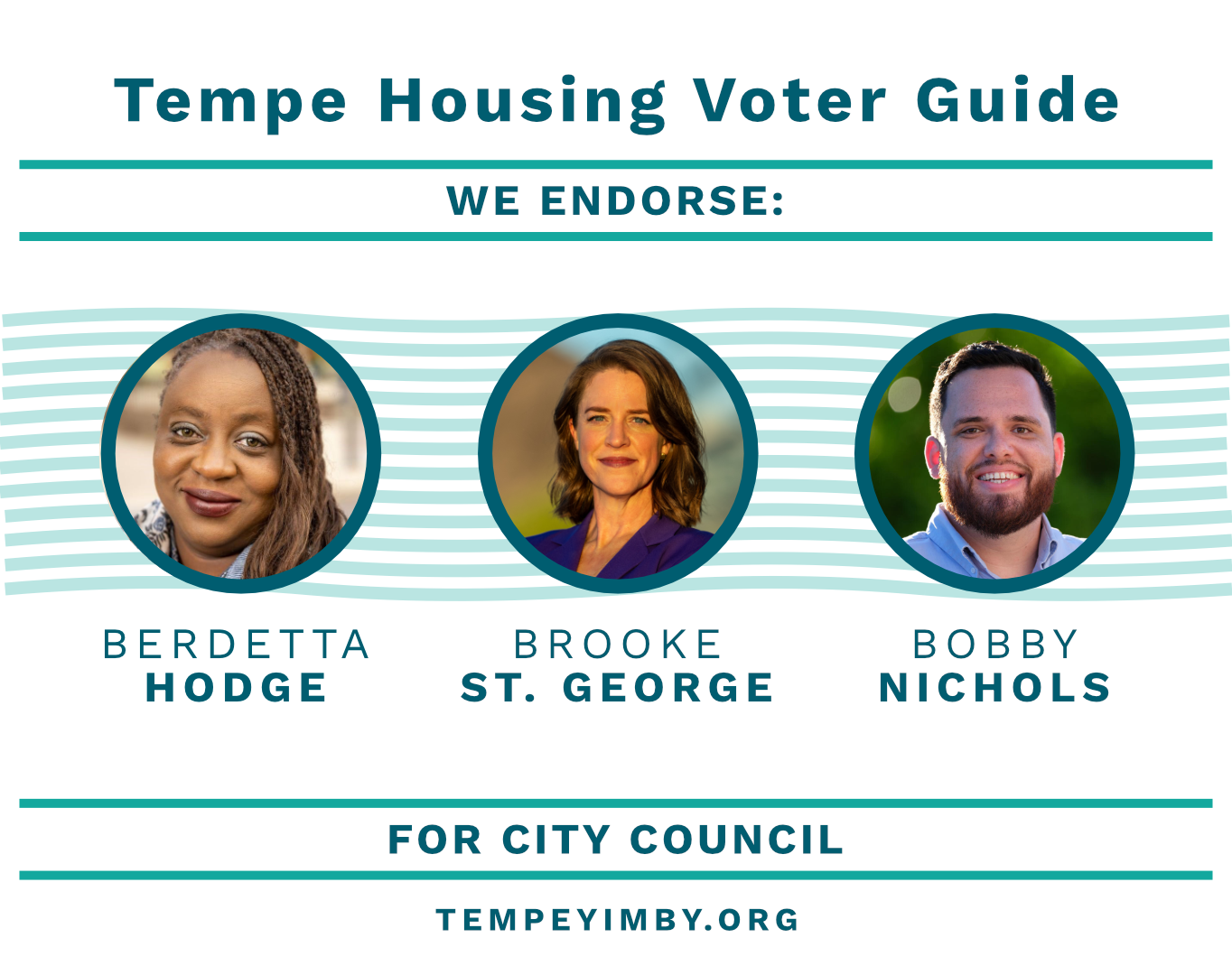
We endorse Berdetta Hodge, Brooke St. George, and Bobby Nichols for Tempe City Council. Read on to see why.
The Litmus Test
In 2024 voters were presented with a choice between the status-quo or explicitly NIMBY candidates who would have taken Tempe backwards.
There was a clear choice in that election. Now there’s a tougher one.
We have been frustrated with the pace and approach the City Council has taken towards implementing housing reforms. A proposed ADU ordinance was slowwalked by council, taking long enough that the state legislature beat Tempe to the punch, requiring cities to adopt a far-better ADU policy. An opportunity to expand Missing Middle housing citywide was watered down. The project-by-project discretion this council has used has sometimes resulted in poor decisions, such as killing a student housing project right across from ASU campus and the streetcar.
This year we wanted to see clear support for actionable policies that would make it easier to build housing in Tempe. We asked about reducing parking mandates for student and affordable housing, policies that would make housing cheaper. We asked about reducing minimum lot sizes to spur the construction of starter homes. We wanted to see unequivocal support for these simple yet high impact reforms.
We also asked some questions about topics deeply intertwined with housing, such as transit and making Tempe an attractive place for families to live, an increasingly important topic wth Tempe schools facing enrollment issues.
What the candidates said
All candidates agreed that there was a housing shortage placing pressure on Tempe residents and seemed to understand the root cause of housing affordability well.Hodge and St. George impressed us by emphasizing the need for more housing supply without caveats in their responses.
When asked how candidates would approach housing affordability, there were a variety of answers. Adams and Chin cited a number of approaches, including strengthening Hometown for All. Bobby Nichols wants to use a density bonus program, rental subsidies and rent stabilization, and a public housing option. St. George mentioned allowing churches to use their land for affordable housing. Hodge called for allowing a variety of housing options like townhomes as well as streamlining the permitting process and pursuing more HUD funding and state housing grants.
As we drilled down into specifics, more contrast emerged between the candidates. Bobby Nichols, Brooke St. George, and Berdetta Hodge all supported reducing lot sizes to spur the construction of starter homes without equivocation. Adams and Chin expressed openness to it, but with heavy caveats.
When asked about reducing parking requirements for affordable and student housing developments, we likewise saw the same pattern. Nichols went beyond the question, supporting lowering parking requirements in general. Hodge and St. George expressed a clear understanding of the policy benefits. St. George also highlighted how reducing parking requirements promotes Tempe’s climate and transit goals. Again, Adams and Chin hedged, advocating a case-by-case approach.
When asked how they would make Tempe an attractive place for families to live, we received a variety of answers. Adams and Chin cited safe neighborhoods, schools, and parks and touted their investments in these. Hodge likewise mentioned schools and also the need for attainable housing for families. St. George specifically emphasized the need for more family-friendly housing to be built in Tempe. Nichols answered that he would support public investment in housing, transportation, nutrition, and childcare for working families.
In general, all candidates supported increasing the frequency and reliability of Tempe’s public transit and expanding protected bike lanes to some degree. Bobby Nichols called for increasing the number of trains and buses to decrease wait times as well as expanding protected bike lanes across the city. Adams cited her experience as Chair of Valley Metro’s RPTA Board, and securing funding for Tempe’s transit system. Hodge specifically mentioned expanding transit-oriented development.
Examining Candidate Responses
Berdetta Hodge knocked it out of the park on nearly every answer. She named some of the biggest barriers to housing affordability in Tempe, like the permit approval process, and overly restrictive zoning.
We believe she has more than earned this endorsement, and we hope to see her make an aggressive push for the policies she mentioned.
Brooke St. George also gave excellent answers. She frequently went beyond the minimum answer and demonstrates a clear view on the issues. We particularly liked her discussion of housing policy as part of making Tempe a compelling place to live for families.
Bobby Nichols is an interesting case. It is clear that many of his ideas involve significant public investment, which may be challenging in the face of a tight fiscal situation for the city. Some policies he proposes, like rent stabilization, could have negative impacts on housing supply and overall affordability if poorly designed.
Regardless, he clearly answered key specific policy questions on parking and starter homes, and called for a wider reduction in parking minimums. We believe the council is more likely to face a vote on parking changes than some of his other policies. And his openness to these land-use reforms puts him over the top.
We think the pro-housing agenda complements many of his policy proposals: Lowering the cost of overall cost of housing allows rental subsidies to go further. The same regulatory barriers that prevent market-rate housing from being built also restrict public housing. And expanding our housing supply through infill development grows Tempe’s tax base and makes financing city services easier.
Jennifer Adams and Arlene Chin provided reasonably good answers to many questions. But we were left disappointed with their responses on fairly easy policy questions that would have a high impact on affordability.
Too often, they both presented these policies as being in tension with “neighborhood character” and “livability.” We have to push back on this. There is nothing worse for neighborhood character than people being priced out of neighborhoods. There is nothing worse for livability than our neighbors not having a place to live. This mindset has led to Tempe putting together very little in terms of housing reform while being outpaced by bipartisan housing reforms from the state legislature.
Both candidates are respectable public servants who are likely to be reelected and we believe would continue to serve Tempe well.
Going forward
Nearly all candidates mentioned strong schools as a priority. But school districts in Tempe are facing challenges as enrollment declines. Ensuring affordable options for young families to live must be a priority for the next council. Starter homes and expanding Missing Middle housing across the city must be a part of this conversation.
Many candidates also mentioned some form of streamlining of the permitting process for housing, particularly affordable housing. We think this should also be a top issue, removing barriers to building new affordable housing and making sure existing funding sources are able to build as many new affordable units as possible.
Regardless of who wins, we’d like to see the next council prioritize these issues and hope to work with them to build a more affordable Tempe for all.
